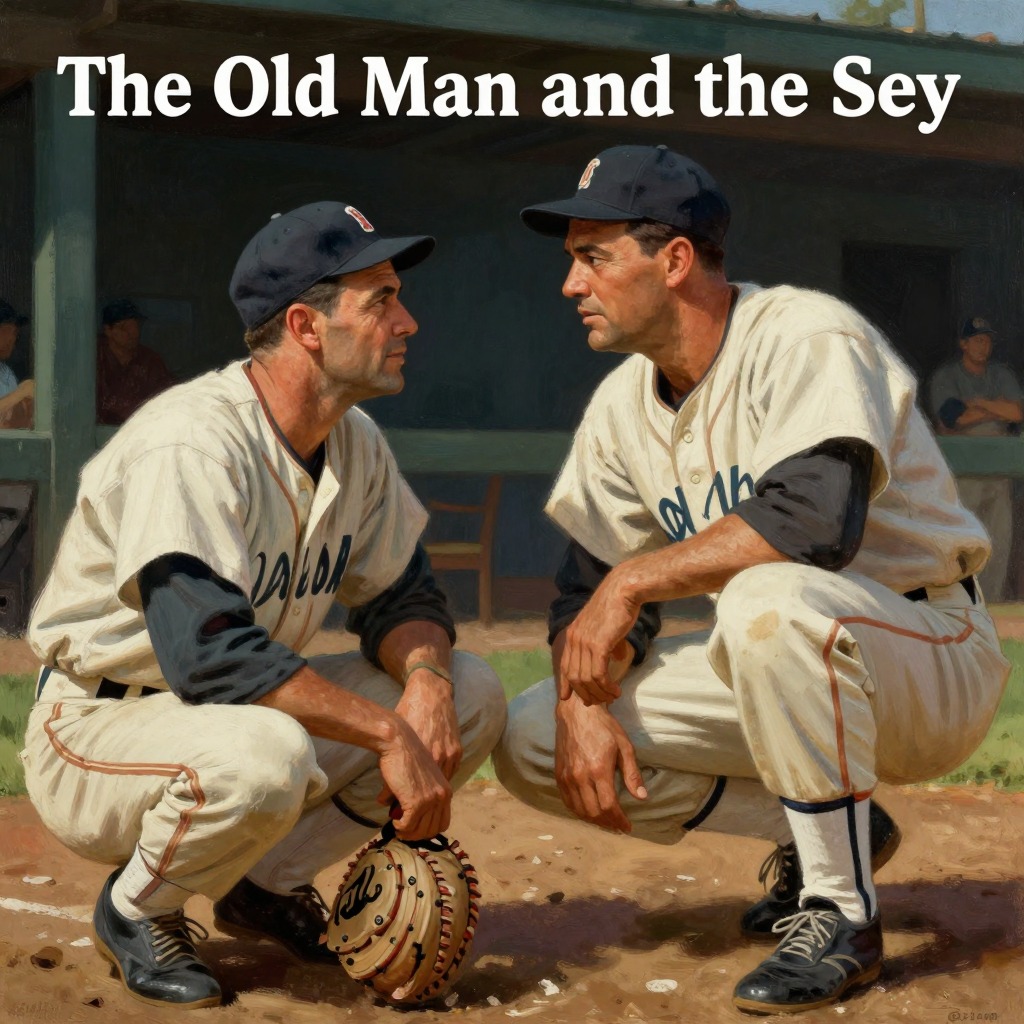
New York Yankees
For Santiago, the old Cuban fisherman at the heart of Ernest Hemingway's The Old Man and the Sea, the New York Yankees are far more than a baseball team. They are a living symbol of greatness, a yardstick for his own endurance, and a vital link to a world beyond the solitary expanse of the sea. Through his conversations with the boy Manolin and his own internal monologue during his epic battle with the marlin, the Yankees—and especially their star player, the great DiMaggio—become a touchstone for the themes of pride, suffering, and undefeated will that define Santiago's quest.
The Yankees as a Symbol of Unwavering Faith
From the very beginning, the Yankees represent an absolute, almost religious faith in success. When Santiago and Manolin discuss baseball on the evening before the old man's fateful voyage, Santiago declares with unshakeable conviction, "The Yankees cannot lose." This is not a prediction but a statement of belief in a natural order where excellence prevails. Even when Manolin reports that the Yankees lost that day, Santiago dismisses it as a temporary aberration: "That means nothing. The great DiMaggio is himself again." For Santiago, the team's identity is inseparable from its star player; DiMaggio is the embodiment of the Yankees' invincible spirit, a figure who "makes the difference" and whose return to form restores the natural balance of the world. This faith in the Yankees provides Santiago with a stable point of reference in a life marked by poverty and a long run of bad luck.
DiMaggio as a Model for Suffering and Endurance
As Santiago's struggle with the great marlin stretches into its second day, his thoughts turn repeatedly to DiMaggio as a model of how to endure pain and perform under pressure. He reflects that he must "be worthy of the great DiMaggio who does all things perfectly even with the pain of the bone spur in his heel." The bone spur, a physical affliction that DiMaggio famously played through, becomes a crucial analogy for Santiago's own suffering—the cut on his hand, the cramp in his left hand, the raw line across his back. Santiago wonders if DiMaggio would "stay with a fish as long as I will stay with this one," and he answers himself with certainty: "I am sure he would and more since he is young and strong." By measuring his own ordeal against DiMaggio's legendary toughness, Santiago transforms his physical agony into a test of character, a way of proving himself worthy of the company of the great. The Yankees, through their star, provide a secular saint whose example sanctifies Santiago's own suffering.
The Yankees as a Link to the World and a Measure of Pride
Beyond personal endurance, the Yankees connect Santiago to a larger community and a shared culture. He thinks of the rich men who have "radios to talk to them in their boats and to bring them the baseball," a luxury he lacks. Yet his knowledge of the game and his admiration for its heroes are a form of wealth he possesses. He imagines taking the great DiMaggio fishing, believing that "his father was a fisherman" and that he "would understand." This fantasy is not just about meeting a hero; it is about bridging the gap between his own humble, solitary life and the world of fame and achievement. The Yankees represent a standard of excellence that Santiago aspires to, and his ability to discuss the team, its players, and its rivals (the Tigers of Detroit, the Indians of Cleveland, the Reds of Cincinnati) is a mark of his dignity and his place in a wider human conversation. After killing the marlin, he thinks, "I think the great DiMaggio would be proud of me today. I had no bone spurs. But the hands and the back hurt truly." This is his final, private judgment of his own performance, measured against the highest standard he knows.
The Yankees and the Philosophy of the Undefeated
The Yankees' most profound role is to embody the philosophical core of Santiago's struggle: the idea that a man can be destroyed but not defeated. When Santiago declares, "A man can be destroyed but not defeated," he is articulating a code of conduct that the Yankees, in his mind, perfectly represent. They are a team that can lose a game but never loses its identity as champions. This is the same spirit that drives Santiago to fight the sharks long after hope is gone, to refuse to admit defeat even as his prize is stripped to a skeleton. The Yankees are not just a team; they are a living proof of the principle that true defeat is a matter of will, not of circumstance. In the end, as Santiago sleeps and dreams of the lions, the Yankees have served their purpose: they have given him a language to understand his own heroism, a standard to measure his own soul, and a way to feel connected to a world that, for three days, he has left far behind.